
Kalamazoo County Deed Types
The Register of Deeds records instruments that convey or encumber land. Recording makes a document public, but the county is clear that recording alone does not make it legally valid. The office drafts nothing and issues no title opinions.
| Deed Type | What It Does | Common Use |
|---|---|---|
| Warranty deed | Conveys land with stated covenants | Ordinary sale |
| Quitclaim deed | Conveys the interest held | Family or title cleanup |
| Trustee deed | Conveys through a trust fiduciary | Trust administration |
| Executor deed | Conveys through an estate fiduciary | Probate transfer |
| Sheriff or clerk deed | Records a court-linked conveyance | Foreclosure process |
A deed conveys an interest. A mortgage, lien, land contract, or lis pendens can burden or flag the property without being its ownership deed. Releases and discharges, meanwhile, show when certain recorded claims were cleared.
Kalamazoo Deed Search Fields
The county interface offers several routes into the same recorded index. Start with the strongest key you know. Use a second field to narrow any long result list. Basic Deeds Search is free. However, it stops at 500 results.
| Search field | Best use | Caution |
|---|---|---|
| Grantor / grantee name | Find a conveyance by party | Try initials, prior names, trusts, and business variants |
| Recording date and type | Narrow a known period | Use recording date, not assumed closing date |
| Liber and page | Open a cited instrument | Copy both values exactly |
| Instrument number | Retrieve a modern filing | Do not confuse it with parcel number |
| Parcel | Cross-check known land | Portal formatting can differ |
Address searching is the least dependable path because an address was never a required recording element. Names and legal descriptions remain the core of deed records work.
View the Kalamazoo Deed Index
The official Kalamazoo County Deeds Search displays the name, date/type, liber/page, instrument, and parcel panels together on one screen.
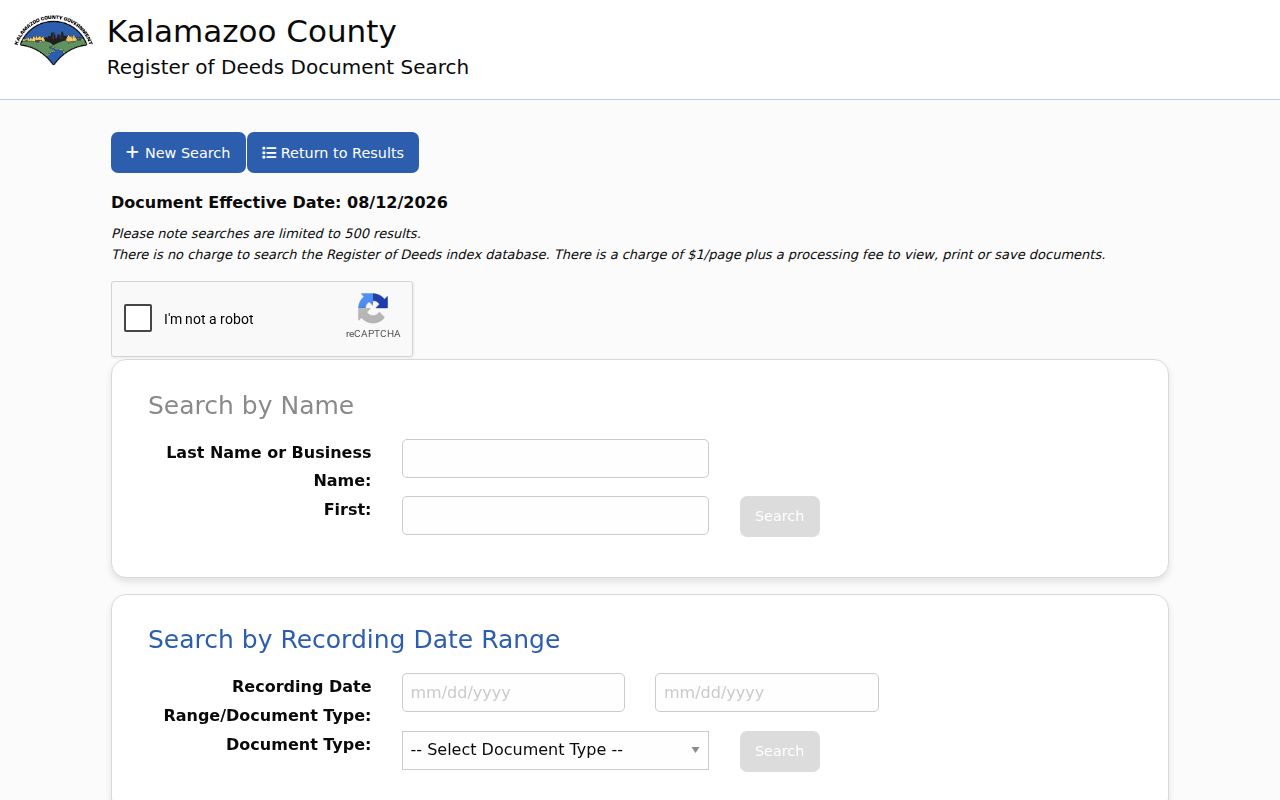
The screen makes the fallback path visible. A broad surname hitting the result cap is a cue to add a date or deed type. When a deed cites liber and page, go straight to that panel instead of rebuilding the search from scratch.
Kalamazoo Deed Coverage Since 1831
Kalamazoo County reports land-record images back to 1831 and a complete index back through 1984. An image date and an index date measure different things. A pre-1984 blank name result may reflect older indexing rather than a missing deed.
Coverage check. Move to physical indexes, deed books, or microfilm before concluding that an older Kalamazoo County deed does not exist.
The FamilySearch catalog identifies deeds from 1831 through 1901 and indexes from 1831 through 1903 across 54 reels of original courthouse microfilm. Its volume notes point you to the right reel. That saves time before a visit or research request.
Kalamazoo Deed Books on Microfilm
The FamilySearch Kalamazoo deed catalog lists early index volumes, deed books, film numbers, and digital group references in one place.
Digital access may depend on a FamilySearch center. Record the volume, year span, film number, and digital group number so a counter or library request targets the correct material the first time.
Kalamazoo Grantor-Grantee Chain
The basic Deeds Search works best by party name because an address was never required for recording. Verify the parcel and legal description at each step of the chain.
- Search the current grantee's name and likely transfer range.
- Open the deed and read its grantor and legal description.
- Search that grantor as an earlier grantee and repeat.
- Use books, microfilm, and counter help when indexing thins out.
- Grantor
- The party transferring an interest.
- Grantee
- The party receiving an interest.
- Chain of title
- The linked sequence of recorded transfers.
- Liber/page and instrument number
- Two identifiers for a recorded document.
Ways to Access Kalamazoo Deeds
Occasional users can search the basic online index at no charge. Tapestry EON costs $8.75 per search with no membership. It became effective October 21, 2024. Images carry the standard charge on top. Laredo, a downloadable monthly-fee service requiring an agreement, suits regular searchers. In-person public workstations at 201 W. Kalamazoo Avenue are free to search. The Register of Deeds is open 8:00 a.m. to 4:30 p.m. Monday, Tuesday, Thursday, and Friday, and 9:00 a.m. to 4:30 p.m. Wednesday. Call 269-383-8970 when a physical index or staff lookup is needed.
A written county FOIA request is another fallback for a defined public record. Submit it through the portal, in person, by email, fax, or mail. Identify the instrument, parties, parcel, date span, and department as closely as possible. That helps the request land with the right office.
Recording Kalamazoo Land Instruments
The recording fee is $30 per document. Card payment is handled by phone or in person. The office has no online payment portal for recording. E-recording is also accepted through CSC, ePN, Indecomm, and Simplifile.
Certain instruments require tax certification before recording. These include warranty and covenant deeds, land contracts, assignments with a warranty clause, and master deeds adding condominium property. City of Kalamazoo land also needs a city tax certificate. The city fee is $10 through the City Treasurer.
Recording gives public notice, but it does not cure an invalid document. Staff do not prepare deeds, perform title searches, or give legal advice.
Kalamazoo Name-Monitoring Alert
Kalamazoo County offers a free Property Fraud Alert that watches a registered name in newly recorded material. The county alert signup allows email or telephone notification when a match appears.
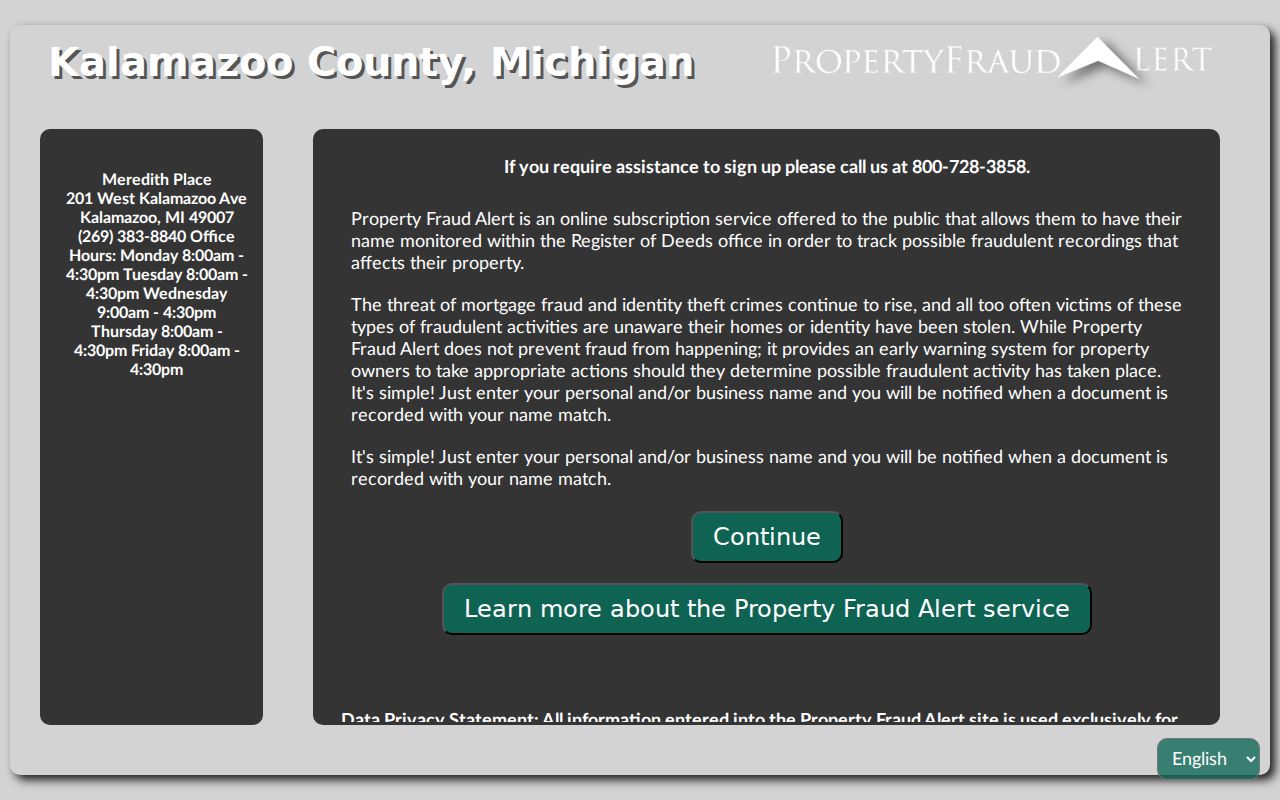
An alert is a prompt to inspect a filing, not automatic fraud prevention or title insurance. Register spelling variants when appropriate, and contact the Register of Deeds about any unfamiliar instrument.
Kalamazoo Estate Deeds and Death Records
An estate can break a clean seller-to-buyer chain in Kalamazoo County. A deceased owner's interest must be shown as relinquished. So the county requires an official death certificate to be recorded. A photocopy will not work. Once recorded, that certificate joins the permanent land trail. The later conveyance may be signed by an executor, administrator, personal representative, or trustee. So a careful property search should cover both the decedent and the fiduciary. Name either one in the deed records and the chain stays intact.
Kalamazoo Probate records reach back to 1832. Records from 1832 through 1990 sit on microfilm. Files from 1990 through 1995 remain in paper form. The online index covers 1995 forward, along with active older matters. That index can reveal the case number, type, status, filing date, attorney, fiduciaries, and document entries. Images, though, are not offered online. To view files in person, visit Probate Court at 1536 Gull Road. Plan around its published counter hours.
Tie the probate case to the parcel deliberately. Compare names, dates, fiduciary capacity, the legal description, and the recorded deed or certificate. Draw conclusions only after that review. A will or estate order may explain where the authority came from. The Register of Deeds record, in turn, shows what actually entered the public land chain. Treat the two sources as separate proofs. Neither one can stand in for the other.
Kalamazoo Deed Consideration and Tax
A deed image often holds stated consideration or transfer-tax evidence. This can be true even when the index lacks a clean sale-price field. Kalamazoo County explains transfer tax as a calculation on stated consideration. It is rounded up to the next $500. Exemptions may apply. Read them from the instrument itself or from the cited exemption. Do not guess from a low or nominal amount. A number that looks like a bargain price may simply be an exempt instrument.
Recorded consideration is not market value, assessed value, or taxable value. Family transfers, trust work, estate deeds, and land contracts can all make the deed figure a poor price comparison. Exempt instruments can too. Use it only as evidence of that one recorded transaction. Then set it beside the municipal sale-history row and the assessment year for context.
Some deeds require tax certification before recording. The list includes warranty and covenant deeds, land contracts, and certain assignments. Master deeds adding condominium property are on it too. City of Kalamazoo parcels also need the city tax certificate the county describes. Certification is a recording step, nothing more. It does not prove every tax issue or title defect has been resolved.
Kalamazoo legal-description checks begin with the land. Party names alone can join the wrong land to a chain. Before accepting a result, compare the subdivision, lot and block, metes-and-bounds text, municipality, parcel number, and any prior deed reference. A split or combination can change the APN while the legal description still preserves the link to an older tract.
Two same-name deeds may both seem plausible. Break the tie with a spouse or co-grantee, a fiduciary role, the recording date, or adjoining-owner language. The GIS polygon helps with orientation. It cannot replace the recorded description or the plat.
Get a Kalamazoo County Deed
Index searching is free. Online viewing, saving, or printing runs $1 per page plus processing. County instructions identify a $2.50 technology fee. A staff lookup costs $5 per property plus $1 per page, with certification adding $5. Public workstations at 201 W. Kalamazoo Ave. are free to search, and prints there are $1 per page.
Match the copy type to its purpose. A downloaded image serves ordinary property research fine. But an office-certified copy carries the custodian's certification. Ask the receiving court, agency, or professional which form it needs before you pay. For a staff lookup, supply the property address, parcel number, current and former party names, a date range, and any known liber/page or instrument number. Precise clues cut the risk of paying for the wrong same-name deed record.
Read the deed image as a whole document. Compare the parties, marital or fiduciary capacity, and deed type. Weigh the execution and recording dates, legal description, consideration or transfer-tax evidence, exemptions, and prior-recording references. Attachments may include an exhibit holding the full legal description. A parcel card can point toward the likely instrument. It cannot replace the recorded text. For a long historical chain, the Kalamazoo former owners resource focuses on moving backward across many transfers. This deed page centers on finding and obtaining one specific recorded instrument in the Kalamazoo County property records.
Recorded, not guaranteed. The index shows filed instruments, not every possible interest or defect. A recorded deed is not a county title opinion.