
Kalamazoo County Ownership Timeline
Work from the newest deed backward to uncover each owner of record in Kalamazoo County. The Register of Deeds keeps the official land records. Recording is what makes an instrument public. Recording does not validate the instrument, though. Nor does it replace a title examination. The sources here each hold one piece of the ownership history.
| Source | Years It Covers | Where Held | What It Shows |
|---|---|---|---|
| County deed images | 1831 to present | Register of Deeds / Deeds Search | Recorded parties, legal description, date and deed type |
| Complete electronic index | 1984 to present | Deeds Search | Reliable modern grantor and grantee searching |
| Deed books and indexes | 1831 to 1903 cataloged | Register of Deeds / FamilySearch | Earlier owners by volume and page |
| Plat approvals | 1915 to 1942 | Archives of Michigan | Subdivision and lot context |
Start your Kalamazoo County property search online if the transfer is recent. A pre-1984 lookup can miss a name even when the deed image still exists. Take the liber and page to the courthouse indexes. Or try the cataloged microfilm for those earlier years. A legal description outlasts a street address, and it helps rule out a same-name owner.
The 1984 Kalamazoo Index Divide
Kalamazoo County says every land-record image dates to 1831. But the complete index only reaches 1984. Those are two different promises. A blank modern result before that cutoff proves nothing about whether a deed exists. Check the physical indexes, the microfilm, or the index books. Test spelling variants while you search.
Index limit. Treat pre-1984 electronic results as incomplete and move to deed books or microfilm before ending a former-owner search.
The free basic Deeds Search also stops at 500 results. Trim a common surname with a date, document type, liber and page, instrument number, or parcel number. Kalamazoo County recommends names over addresses, since a street address is not a required element on a recorded deed.
See Kalamazoo Deed Search
The county's official Kalamazoo County Deeds Search splits its lookups into separate panels. You can search deed records by name, by date and document type, by liber and page, by instrument number, or by parcel.
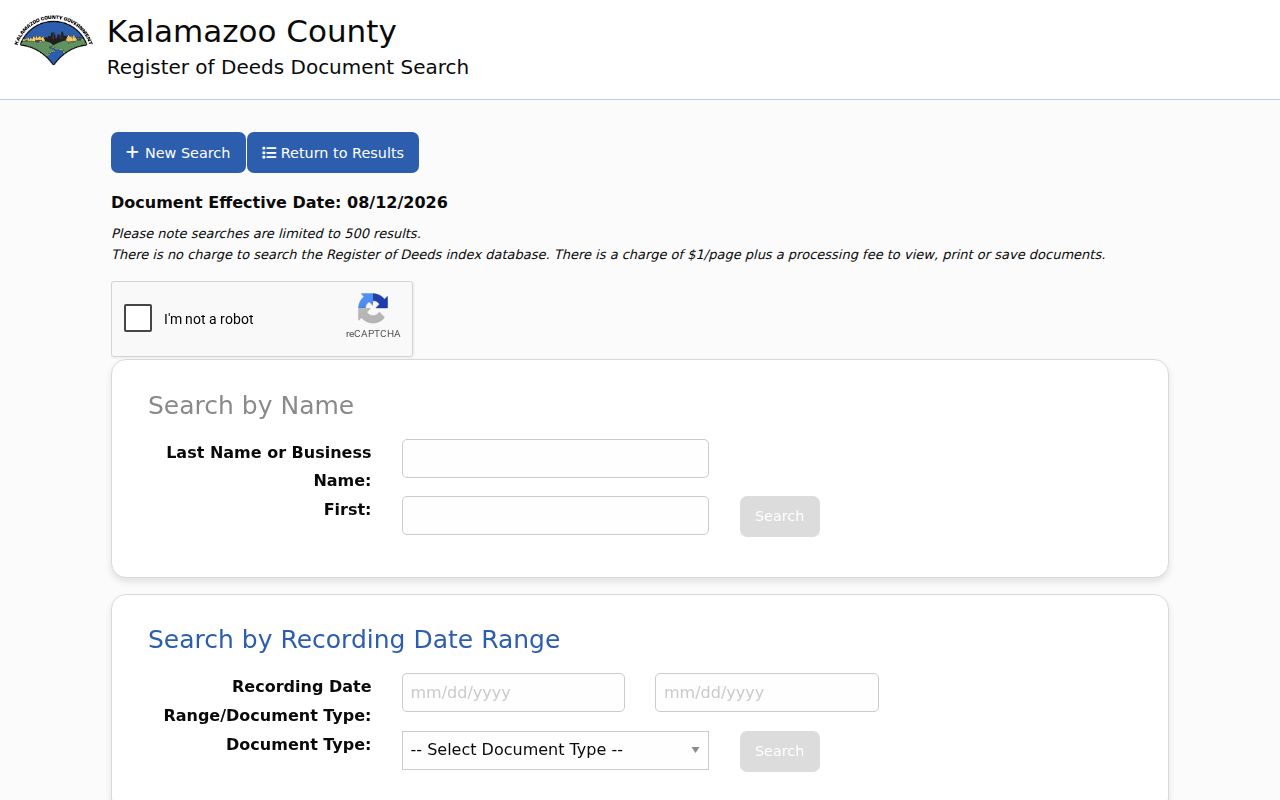
Those separate panels rescue a stalled search. When a surname is misspelled in the index, a prior deed's liber and page can carry you past the error. A parcel number works even better. It ties a changed owner name back to the same piece of land in Kalamazoo County, keeping the property records chain intact.
Walk Kalamazoo Deeds Backward
Walking the deed chain backward is simple. Each recorded transfer you find becomes the seed of your next search. Start with the current parcel card only to pin down the latest owner of record and the exact parcel number, then let the recorded instruments carry the property records back in time.
- Find the current owner's acquiring deed, where that owner appears as grantee.
- Copy its recording date, instrument number, liber/page, legal description, grantor, and prior-deed reference.
- Search that grantor as an earlier grantee, then compare the land description before accepting the match.
- Repeat until the complete-index cutoff, then continue with the reverse index and deed books.
- Grantor / grantee
- The party conveying an interest and the party receiving it.
- Chain of title
- The ordered sequence of recorded transfers affecting the same land.
- Reverse index
- An index organized from a party name toward the instruments involving that party.
- Warranty / quitclaim deed
- A warranty deed carries title covenants; a quitclaim conveys only the interest the grantor may have.
Kalamazoo Deed Books on Film
The FamilySearch catalog lists 54 reels of microfilmed courthouse records for Kalamazoo County. The deed books run from 1831 through 1901. Indexes reach from 1831 through 1903. The catalog's detailed entries also name index volumes 1 and 2, covering 1831 through 1857, plus volumes 3 through 5 for 1858 through 1876, a span that helps researchers thread early deed records parcel by parcel.
When the online index runs dry, reel notes point back to the original deed books. Digitized film access may hinge on a FamilySearch center, so record the film and digital group number before asking staff for help.
Inherited Kalamazoo Property Chains
Estates complicate the trail. A death rarely leaves a clean sale-to-sale sequence in Kalamazoo County deed records. Probate records here begin in 1832. A 1995-current online index exists. Pre-1995 matters are indexed as well. Executor, administrator, and trustee deeds can reveal how title actually moved.
Michigan adds a quirk. An official death certificate must be recorded when it shows a deceased owner gave up an interest. A copy certificate will not do. Match the probate parties, the fiduciary deed, and the property description against each other. The probate file explains who had authority to convey. The recorded deed remains the land-record link. When a name simply vanishes from the sale records, older probate microfilm, courthouse files, and newspaper estate notices can fill the gap.
Kalamazoo Plats Preserve Place
Street names shift. Parcel numbers shift too. A plat name often outlasts them both in Kalamazoo County property records. Its lot and block endure with it. The county's official plat layer displays Name, Recorded, Type, and Municipality fields for each entry. Treat it as a discovery tool. Before relying on any entry, confirm the controlling lot wording in the recorded plat or condominium master deed.
Sequence matters more than searchers expect. South Street was platted in 1841, and West Main Hill's curving layout dates to 1888. Galesburg plats may hide under two names. Both "Village of Galesburg" and "City of Galesburg" appear. A later assessor's replat can also explain a puzzle. It can show why a modern legal description diverges from an older deed without any change in ownership.
Older Kalamazoo Owner Clues
Old newspapers hold answers the deed books skip. The Kalamazoo Public Library's Gazette collection runs from 1837 to the present, and its Local Newspaper Index surfaces sale notices, probate notices, sheriff sales, subdivision advertisements, and building announcements. The Local Information Database adds photographs, magazines, and other history records. Local History Room materials stay in the building. On-site scanning and copying are available.
Written archive requests go smoothest with the city or township, an approximate year, the prior owner, the subdivision, and the legal description. Ask for ordinary and reverse directory runs too. Western Michigan University, the Kalamazoo Valley Museum, the Library of Michigan, and the Archives of Michigan open further map, finding-aid, and microfilm channels. These sources build leads. Only deeds confirm a past owner of record.
How Far Kalamazoo Records Reach
Kalamazoo County's recorded images reach back to 1831. FamilySearch microfilm carries a long nineteenth-century deed and index trail. Older instruments rarely use a street number. Instead, they point to a highway, a creek, a township line, or an adjoining owner. Copy that wording exactly. Those adjoining names often seed the next grantor or grantee search.
Free public workstations at 201 W. Kalamazoo Avenue give another route in. Prints run $1 per page. A staff lookup costs $5 per property plus page charges, and certification adds $5. The county will not draft instruments, give legal advice, or build a title abstract. For tracing previous owners of a Kalamazoo County property, these records work well. A contested title question belongs with a qualified professional.
For every transfer, log a full citation row. Include recording date, grantor, grantee, deed type, instrument number or liber and page, parcel or legal description, and the prior reference. When the chain jumps, widen the date range for both parties. Search mortgages, releases, land contracts, tax-foreclosure documents, death certificates, and fiduciary deeds. A gap may reflect sloppy indexing or a non-sale transfer. It does not always mean an owner is missing from the deed records.
Names drift over time. So search initials, spelling variants, spouses, co-grantees, trusts, trustees, estates, personal representatives, and exact business names. Never join two people on surname alone. The land description, the recorded plat, the municipality, and adjoining owners anchor identity far better than a mailing address. A mailing address can point somewhere else entirely.
Splits and combinations need extra care. Trace the parent legal description before chasing the newer parcel number. A current polygon on the GIS map can hide the earlier lot pattern. Compare the subdivision lot and block, the metes-and-bounds calls, the condominium master deed, and any later amendments. That discipline keeps the backward chain pinned to the same land even after the tax identifier changes.
Finally, keep archive clues apart from proven transfers. A directory entry, newspaper notice, photograph, obituary, or permit can hint at who occupied a property. It still does not put that person in the deed chain. Cite the clue, then hunt the recorded conveyance that confirms the former owner of record. If no matching deed surfaces, leave the question unresolved rather than filling the gap with circumstantial evidence.
Lawful use. Former-owner research supports house history, estate work, and purchase diligence; never use personal details to stalk, target, or harass anyone.