
Kalamazoo County Tax Record Fields
The tax story in Kalamazoo County lives in three places. The municipal assessment roll, the local treasurer's current account, and the County Treasurer's delinquent account each hold a piece. Assessor cards are the richest source. They commonly list the owner of record, parcel number, class, assessed value, state equalized value, taxable value, Principal Residence Exemption status, sale history, and land or building details. Tax screens then add billed amounts and payment history. No single field can replace the rest.
| Field | What It Shows | Where |
|---|---|---|
| Assessed value and SEV | Annual assessment and equalized amount | Municipal assessor or BS&A |
| Taxable value | Value to which millage is applied | Assessment roll and bill |
| PRE status | Principal Residence Exemption shown on the roll | Municipal assessor |
| Current bill and payments | Charges, installments, and receipts | Local treasurer or BS&A |
| Delinquent balance | County-held unpaid tax and changing payoff estimate | County Treasurer |
Michigan works from true cash value. Assessed value generally equals half of it. Proposal A caps taxable-value growth each year until a property transfers and the cap comes off. A sale price is only evidence. State law bars treating price alone as true cash value, which is why a bill, an assessment, and a deed's stated consideration can disagree.
Three Kalamazoo Tax Systems
The County Equalization Parcel Search opens the door countywide. Enter an owner name, parcel ID, or street. Results point you to the city, village, or township keeping the freshest assessment roll. Kalamazoo and Portage run on BS&A Online. Other municipalities are reached through links on the county page.
Current-year tax belongs to the local treasurer. Delinquent balances move to the Kalamazoo County Treasurer after the last day of February. That office takes online, mail, and drop-box payments. Mail payers should include the parcel number or property address. The counter sits at 201 W. Kalamazoo Ave., with phone help at 269-384-8124.
Keep the channels straight. The local roll explains value and the current bill. The county account controls delinquent years and payoff figures. Equalization offers the broad county search but never replaces a municipal assessor's active record.
BS&A Tax Details in Kalamazoo
The Kalamazoo County BS&A entry point leads to tax and payment records by municipality. It separates the property card from the tax account. Property Information carries the current owner, assessed and taxable values, class, PRE status, land and building facts, and sale history. Tax Information holds the bill itself. Building Department tabs add permit history where a municipality publishes it.
| Search or tab | Use | Check next |
|---|---|---|
| Address | Open one parcel from a known site | Match city or township |
| Parcel number | Avoid street spelling conflicts | Keep the exact displayed format |
| Property Information | Read values, class, PRE, owner | Confirm assessment year |
| Tax Information | Read bill and payment entries | Separate current from delinquent tax |
The captured county tax entry illustrates where Kalamazoo County property tax searches begin.
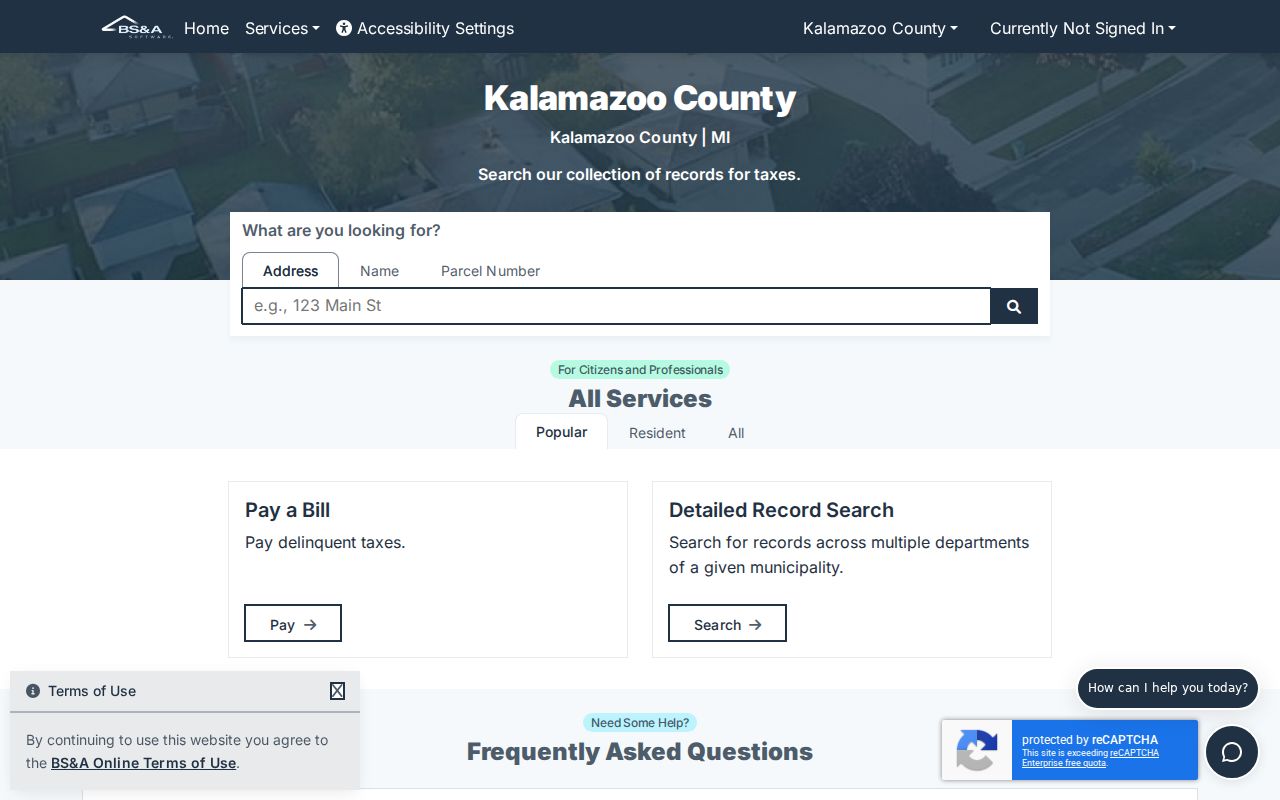
Its municipality choice matters because the local unit keeps the current assessment and bill.
Look Up a Kalamazoo Tax Bill
Stick to one parcel number. A mailing city can mislead you. Check the year on each screen too, since the balance only makes sense beside it.
- Use County Parcel Search to identify the parcel ID and correct municipality.
- Open the municipality's assessment card and note assessed value, SEV, taxable value, class, and PRE status.
- Read the local Tax Information tab for the current bill and payment entries.
- For an unpaid prior year, use the County Treasurer's delinquent lookup and call for a current payoff before paying.
- Assessed value
- The assessor's annual value, generally one-half of true cash value in Michigan.
- Taxable value
- The capped value used with millage to calculate tax.
- Millage
- A tax rate stated in mills and applied to taxable value.
- Principal Residence Exemption
- A qualifying owner's exemption from up to 18 mills of local school operating tax.
- Tax lien
- The government's claim arising from unpaid property tax.
Note: A PRE flag backs up a homestead exemption claim, yet it proves neither occupancy nor legal title on its own. Treat it as one clue among several.
Kalamazoo County Delinquent Tax
The Delinquent Property Tax Lookup gives a free balance and an estimated payment figure. Estimates can shift. Assessor adjustments, statutory interest, service costs, and later fees all play a part. Ask the Treasurer directly. Exact payoff figures come from that office.
One local trap is stale status. Kalamazoo County warns that a local unit's site may keep listing a delinquent amount even after payment reached the County Treasurer. Use the local site for current-year property tax records and the county for delinquent years, and check the Treasurer's payment page for online, mail, and drop-box options.
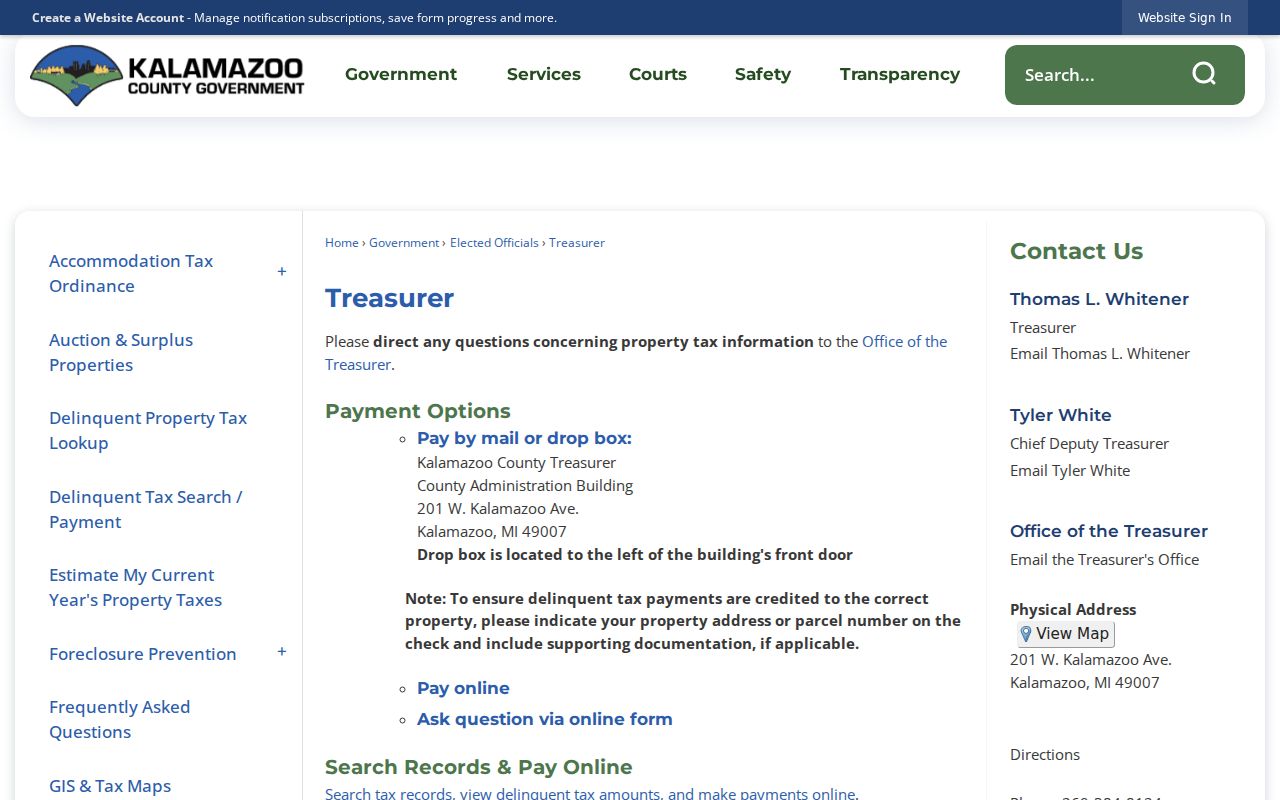
The separate routes explain why the same parcel can appear to have conflicting payment status.
Kalamazoo Tax Foreclosure Calendar
Kalamazoo County posts a detailed five-year tax foreclosure timeline. Tax turns delinquent after February 28. Forfeiture follows one year later. Foreclosure lands in year four. Auction arrives in late summer or fall of that year. Costs keep stacking up along the way. Notices, title work, publication, recording, redemption, and interest all add to the balance. Each charge lands as a case advances.
The county's official timeline is the page to recheck. Statutory dates and charges can change.
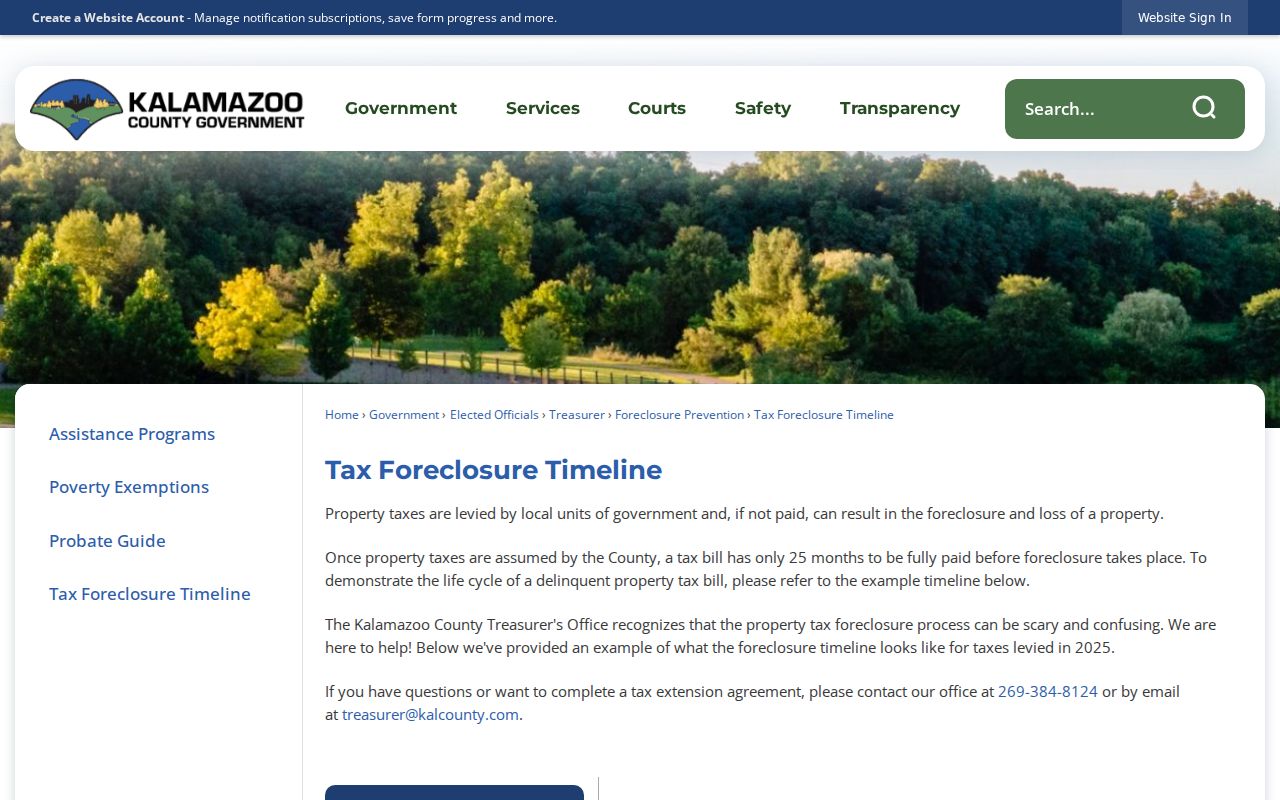
A tax account can hold more than a bill. It may link to forfeiture documents, court action, a recorded foreclosure instrument, or an auction record.
Kalamazoo Property Tax Exemptions
Michigan's Principal Residence Exemption removes up to 18 mills of local school operating tax. It applies only to a qualifying principal residence. Ownership matters. So does occupancy. The exemption shifts taxable treatment, never the deed or market price.
Owners file for PRE with Form 2368 through the local assessor. Other exemption and correction questions start there too. Keep your filing proof, assessment notice, and parcel card together. The review board will want evidence tied to the parcel and tax year.
Challenge a Kalamazoo Assessment
Every appeal starts locally. Valuation disputes go to your Board of Review, not the County Treasurer. Kalamazoo City hears these cases at its March board. July and December meetings cover only qualified corrections and exemptions. Portage sets its own schedule and runs its own Form 618/L-4035 process. Each municipality posts the operative dates for the year. Compare classification, measurements, building facts, condition, and genuinely similar parcels. A higher tax bill alone does not prove the assessor's value wrong. Submit the local form and proof through the method that board allows. Then keep the decision for any later appeal.
Check the annual window. Valuation protests belong in the March Board of Review cycle; verify the current municipality's dates and filing rules before submitting.
Offline Kalamazoo Tax Access
Online access is only one channel. Equalization staff answer parcel and assessment questions at Room 404 of the County Administration Building. Call ahead for an appointment, since staffing is limited. Municipal assessors explain the current roll and its update. Local treasurers handle current bills. The County Treasurer takes delinquency questions by phone, mail, drop box, and counter. Some county records never appear online. Those need a written Michigan Freedom of Information Act request, filed through the county portal, in person, by email, fax, or mail. Describe the parcel, record type, department, and date range. Historic assessment and land context may also require the Kalamazoo Public Library, Western Michigan University, the Library of Michigan, or the Archives of Michigan.
Bring or send the APN, property address, municipality, tax year, and the exact document sought. That detail matters. It keeps an office from confusing a current assessment notice with a bill or delinquency statement. Equalization can explain countywide data. Only the local assessor can explain the active roll. The Register of Deeds supplies recorded foreclosure instruments. The Treasurer explains debt and payment status.
When you compare years, save each annual card or bill with its date. Taxable value may rise under a cap. True cash and assessed values can move differently. A transfer can uncap taxable value in the following assessment cycle. Additions, class changes, exemptions, and corrections also alter the record, so tie each change to the notice or permit that explains it. Strong research keeps four dates apart: assessment year, bill year, payment date, and deed recording date. Each office organizes its records around a different one. A worksheet with those dates, the parcel number, municipality, values, PRE status, and balance builds a sound audit trail for a purchase review or appeal.
Before you pay or appeal, compare the parcel number on every source. A street label can change. A mailing address may belong to an owner or agent elsewhere. The APN keeps the assessment card, bill, delinquency lookup, exemption form, and recorded instrument tied to one tract. If a payment posts at the county yet lingers on a local screen, save the receipt and ask both treasurers which system carries the authoritative balance for that tax year. Never infer a debt from a stale municipal display.