
Start a Kalamazoo County Property Search
An address is the easiest key. The Equalization Parcel Search run by Kalamazoo County accepts an owner name, parcel ID, or street address. Each result supplies the parcel number that links the local assessor, the deed index, and the GIS map. A street-only query can list a whole block. A number-only query helps when spelling is unclear. Keep the municipality in mind. The county calls its data an annual equalization set and refers users to local assessors for the freshest tax roll. The Register of Deeds holds recorded transfers and encumbrances, while GIS supplies reference geography rather than a surveyed line. The municipal roll shows the tax-roll owner and value fields. Record the source and date beside every fact.
- Search the county parcel gateway by street address and save the parcel ID.
- Open the correct municipal assessor card for owner, value, and classification.
- Search deeds by party name, then narrow by parcel, date, or instrument.
- Use GIS for tax maps, aerials, soils, and wetland context.
- Request a certified copy or inspect older books when online material is not enough.
Where Kalamazoo County Records Live
Kalamazoo County property records live in separate offices. Equalization runs the parcel gateway. The Clerk/Register of Deeds records deeds, mortgages, liens, releases, plats, and easements, while the Treasurer takes over delinquent property taxes once local collection ends.
Kalamazoo County Clerk/Register of Deeds
201 W. Kalamazoo Ave.
Kalamazoo, MI 49007
269-383-8970
Three Keys for Kalamazoo Property Records
The county gateway offers three modes. Parcel mode takes a full or partial ID. It reads 04-12-448-020 with hyphens, spaces, or no punctuation at all, and Street mode accepts any portion of a number and name.
| Search mode | Best starting fact | Useful result |
|---|---|---|
| Street | Number and street | Parcel or street list |
| Owner | Person, trust, or entity | Parcels under that spelling |
| Parcel ID | Full ID or prefix | Precise match |
The deed portal shows a fixed 39 prefix. Its split number fields are portal formatting, so copy the displayed ID exactly and verify it across systems. The official search page displays the three county modes.
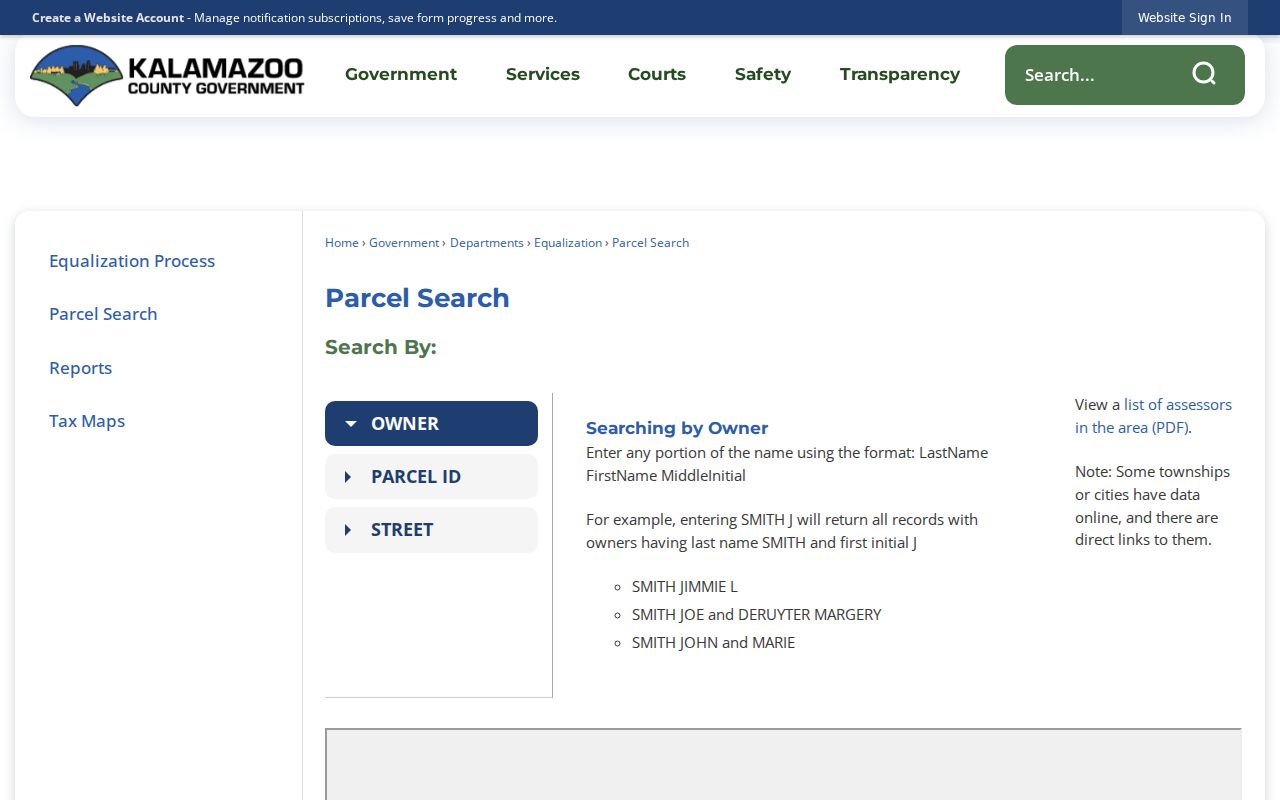
An address can lead straight to a parcel. Deed searches, though, still run better on a party name.
Kalamazoo Deed Images Outrun Indexing
Kalamazoo County land-record images reach back to 1831. The searchable party-name index only runs through 1984. So an early image may exist even when a modern name search misses it. Older work needs physical indexes, counter workstations, or microfilm. The free Deeds Search caps results at 500, and an address was never required for recording. Search by party name first. Date, document type, liber and page, instrument number, and parcel all narrow the set.
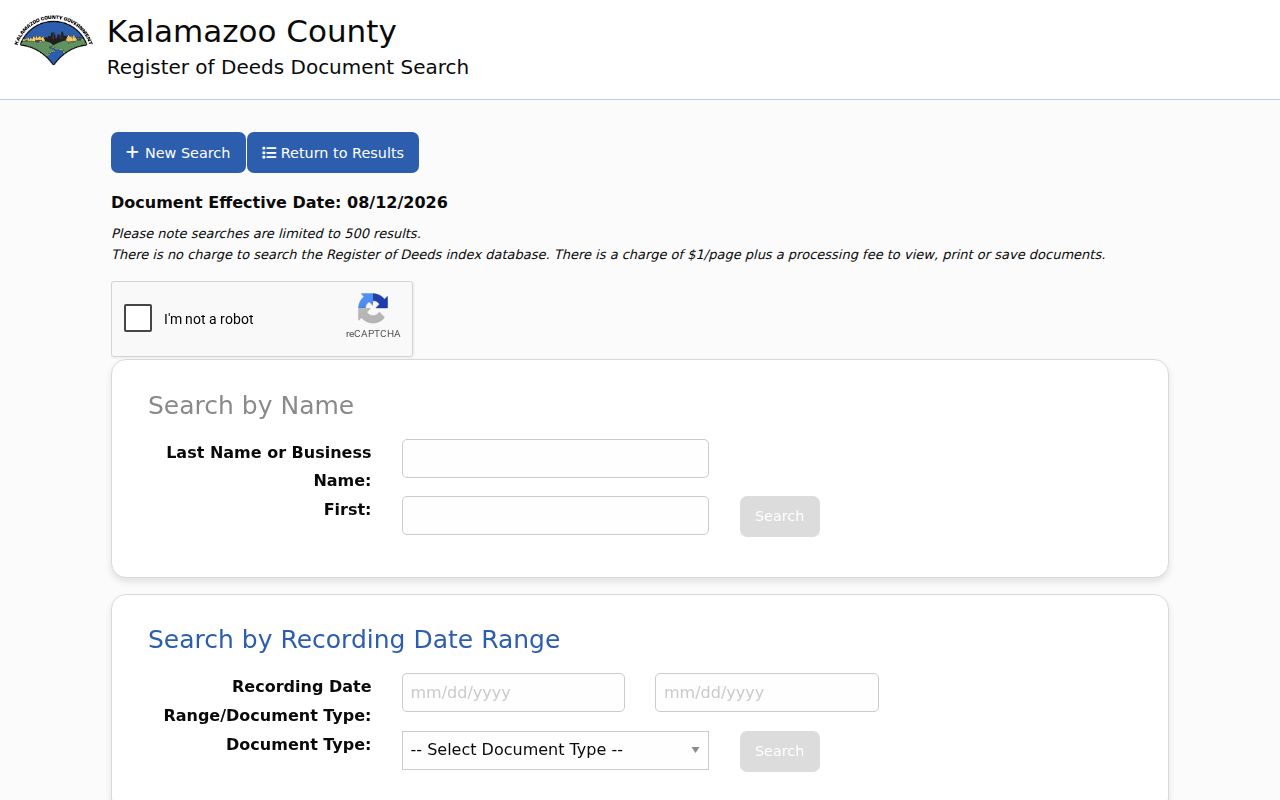
Its fields support a move from a broad name query to one instrument.
Kalamazoo County Property Record Types
No single card tells the whole story. Kalamazoo County property records span title instruments, assessment and tax data, map layers, municipal permit files, and court or probate material.
| Record Type | What It Documents | Kept By | Access |
|---|---|---|---|
| Deeds | Transfers and legal descriptions | Register of Deeds | Free index; paid images |
| Mortgages and liens | Recorded claims and releases | Register of Deeds | Free index |
| Assessment and tax | Owner, SEV, taxable value, PRE, bills | Municipality and Treasurer | BS&A and county links |
| Plats and parcels | Polygons, lots, blocks, recorded plats | GIS and Register | Viewer and plat service |
| Building permits | Work and inspection history | Municipality | BS&A or local forms |
Ownership history and the current roll are different animals. Deeds live in Kalamazoo County deed records. A deed shows consideration and a prior reference, but it never reports the value concepts an assessment card carries.
Kalamazoo Assessment Cards Add Detail
Kalamazoo and Portage both point users to BS&A Online. A municipal card can bundle the current owner, tax information, land and building data, zoning, sale history, tax payments, permit dates, utility bills, and invoices. Labels vary by city and township. Do not assume every field is published. Situs and mailing addresses do different jobs: the situs marks the physical location, while the mailing address receives tax notices and may belong to an agent elsewhere. Neither one proves occupancy. The current-owner field is only a tax-roll entry, so confirm any recent transfer against the deed. The City of Kalamazoo instructions lead to that BS&A card.
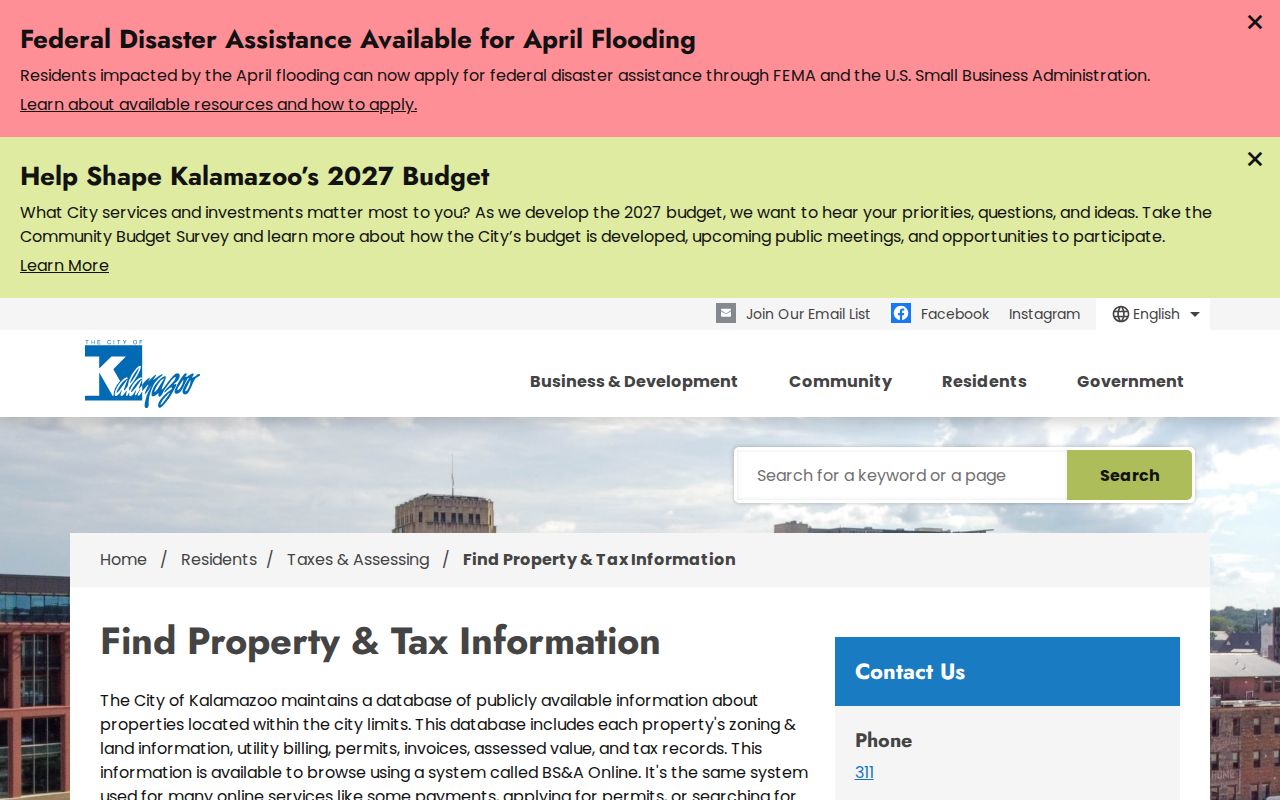
The tabs pull several municipal files together, yet the card is never a certified title record.
Kalamazoo Parcel Maps Need Survey Checks
The county GIS service layers parcel data, tax maps, aerial imagery from 2018 through 2023, soils, and National Wetland Inventory coverage. Parcel data updates annually with the tax roll. It may lag a deed recorded yesterday. Polygons are approximate. They help you spot nearby parcel IDs, identify a plat, or add soil and wetland context, but they settle no fence, easement, setback, or lot-line dispute.
- Parcel or APN
- The county ID linking records across systems.
- Plat
- A recorded subdivision map naming lots, blocks, and dedications.
- Assessed value
- A tax figure, not a sale appraisal.
- Grantor and grantee
- The transferring and receiving deed parties.
Kalamazoo Tax Records Change Hands
Current tax bills start with your city, village, or township treasurer. After the last day of February, delinquent balances move to the county Treasurer. A local card can still show a paid balance. Confirm with the county after the handoff. The county timeline runs from delinquency to forfeiture, foreclosure, and auction across five years. Assessment, State Equalized Value, taxable value, and balance due are different numbers. None states a sale price.
Free Alerts Watch Kalamazoo Deeds
Kalamazoo County offers a free Property Fraud Alert. The county enrollment screen takes a name and a choice of email or telephone notice. It is an early warning, not a filing block.
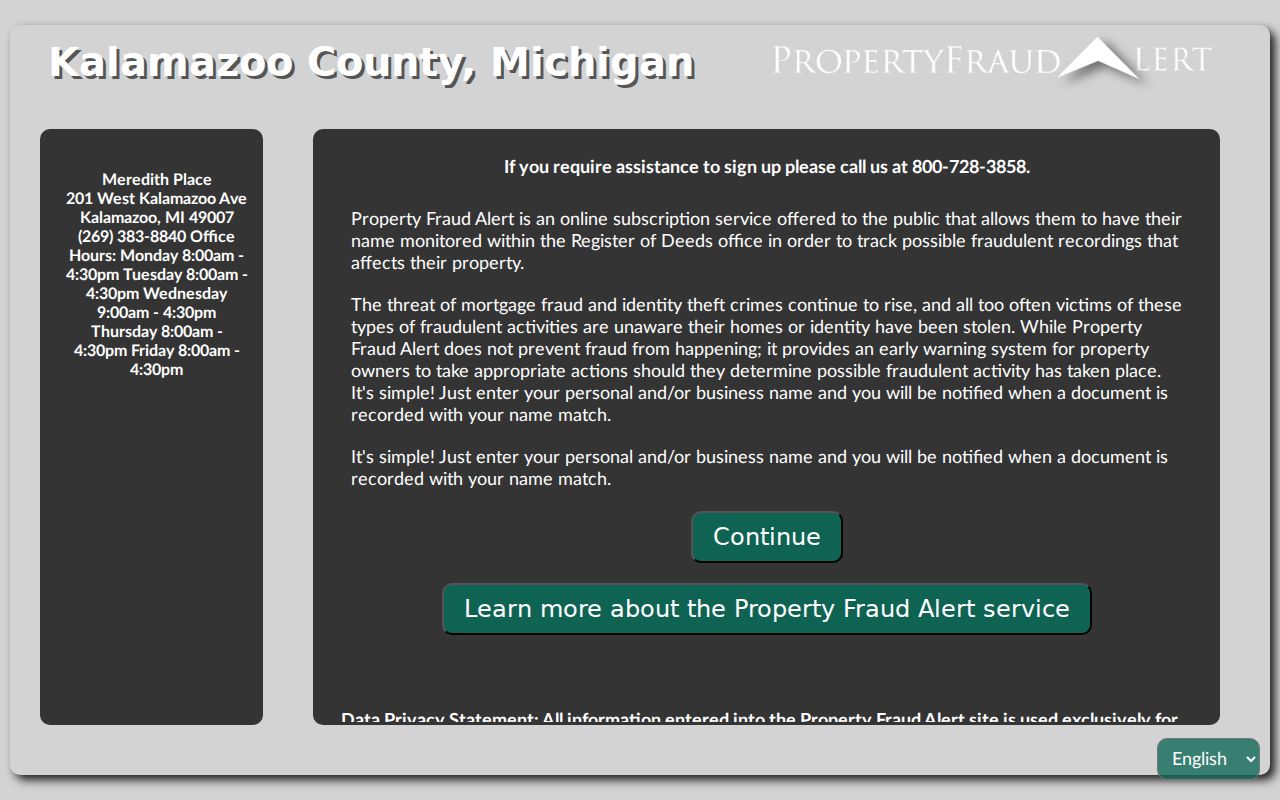
The spelling should match the form used on recorded instruments.
Historic Kalamazoo Records Span Formats
Deed research in Kalamazoo County goes back further than most online indexes reach. FamilySearch catalogs 54 reels of deeds. The reels cover 1831 through 1901. Indexes run from 1831 into 1903. The Library of Michigan also lists a publication drawn from the county's first deed book. Online party indexing sometimes stops short of these years. That film and print layer picks up the trail. The FamilySearch catalog documents the full reel run for Kalamazoo County property records.
Not everything sits on the open web. Some FamilySearch images require a visit to a FamilySearch Center or a library login. The Kalamazoo Public Library adds Gazette newspaper coverage from 1837 forward. The Gazette often carries sale notices and estate announcements tied to land. Probate records begin in 1832. Older files live on microfilm. The online index mainly covers 1995 forward. Those shelves can still explain estate transfers, name changes, and addresses that no longer match the parcel.
Kalamazoo Permits Stay Municipal
Permits are not a countywide product in Kalamazoo County. No single database holds zoning and permit files for every address. The enforcing agency depends on where the property sits. Kalamazoo and Portage both publish property and permit material through BS&A. Galesburg uses city building and zoning applications alongside the county parcel tools. A postal city name alone will not settle the question. Check the taxing municipality on the parcel card before hunting permit files. For City of Kalamazoo parcels, the Building Department tab in BS&A can display permit issue dates and inspection dates. It can also display other permit details. The city asks homeowners and contractors to verify the property in BS&A before starting its permit workflow. Portage offers a comparable address, name, or parcel route. It points users to Building Department records for permit history. Galesburg's applications themselves gather the parcel number, site address, owner or lessee, contractor details, improvement type, zoning district, intended use, and a lot diagram. The paper trail there is unusually rich. Permit history is an administrative record of work. It cannot prove that every visible improvement was permitted, passed inspection, or remains lawful under current zoning. Compare the municipal file against the assessor's building details and dated aerials. Then ask the local building office about any gaps. Kalamazoo County property records work best when these municipal sources serve as one layer, never as a substitute for deeds or surveys.
Kalamazoo Property Cases Need Court Records
A foreclosure, quiet-title suit, construction dispute, or probated estate can arise. Either one can add a court file to the land trail. MiCOURT provides statewide public case information for supported courts. Its display is informational rather than official. Kalamazoo's 9th Circuit Court states that public files are primarily available at clerk counters. They are also available at terminals. Call ahead when an archive retrieval may be needed. The land index itself can reveal plenty. Look for a lis pendens. Also look for a sheriff deed, clerk deed, tax-foreclosure instrument, certified court order, or release. These recorded items point to a case but rarely hold the whole dispute. Match the court number, parties, filing date, disposition, and parcel legal description. Then inspect the public portion of the case at the proper court. Federal property litigation may land in PACER rather than a county portal. Probate runs on its own format in Kalamazoo County. Records begin in 1832. Material from 1832 through 1990 sits on microfilm. The 1990 through 1995 interval survives in file form. The online index covers 1995 forward plus active older cases. That index shows case detail, fiduciaries, and document entries, but no images are online. An official death certificate can be recorded with the Register of Deeds. It can enter a land chain when an owner dies. Read the probate file, the deed, and the death record together to keep the chain honest.
Offline Kalamazoo Record Access Still Matters
Online portals are only one door into Kalamazoo County property records. The Register of Deeds keeps free public search workstations at 201 W. Kalamazoo Ave., with prints at $1 per page. Staff can run a lookup for $5 per property plus $1 per page. Certification adds $5. The basic web index is free. But viewing, printing, or saving an image runs $1 per page plus processing. Occasional paid searches flow through Tapestry EON at $8.75 per query plus image charges. Laredo, by contrast, requires an agreement and monthly fee for regular work. Hours matter for a counter trip. The office is open 8:00 a.m. to 4:30 p.m. Monday, Tuesday, Thursday, and Friday, and 9:00 a.m. to 4:30 p.m. Wednesday. Phone and in-person requests help when a result tops the web index's 500-record cap. They also help if an image is faint. An old name missing from the modern index is another good reason to call or visit. Mail and counter copy requests should identify as much as possible. Party names, instrument number, liber and page, document type, and recording date all speed the search. Equalization sits in Room 404 of the county building and asks for an appointment because staff is limited. The Treasurer supports online search and payment, mail, drop-box, phone, and counter service for its tax role. Michigan FOIA offers another route for county records not already supplied through normal public service. A written request must describe the record well enough to locate it. The law allows a five-business-day response, a ten-business-day extension, and cost-based fees. FOIA does not force an office to create a new report or replace a certified-copy process. Historical access stays mixed. FamilySearch viewing may still depend on a center or library login. The Kalamazoo Public Library's local-history room takes research requests and offers newspaper and local databases. Western Michigan University and the Archives of Michigan hold regional finding aids and collections. A historic source can extend a Kalamazoo County property search. So record the repository and call number for later.
Kalamazoo Address Lines Can Mislead
An address, a taxing municipality, and a legal description answer three different questions. USPS only confirms that mail gets delivered. Equalization or the local assessor decides the taxing unit. The recorded deed holds the legal description. Kalamazoo ZIP codes 49001, 49006, 49007, 49008, and 49009 alone never prove that. A parcel with one of them may still sit outside the City of Kalamazoo. The same warning goes for Portage ZIP codes 49002 and 49024 and Galesburg 49053.
Westwood shows why this matters. The neighborhood straddles the City of Kalamazoo and Kalamazoo Township. Two homes can share the neighborhood name. Yet they answer to different tax, zoning, permit, and assessing custodians. A renamed street can break a simple address match too. So can a split parcel, a combined lot, an assessor's replat. So can a condominium master deed.
When an address search comes up empty, strip it down. Start with just the house number, then the street. Then try the owner name and the parcel prefix. Before you jump to a city portal, compare the map municipality against the legal description. For a subdivision tract, search the official plat layer by its recorded name. Check the Name, Recorded, Type, and Municipality fields on that plat entry. This sequence keeps you from forcing a modern mailing label onto an older deed. Or onto an older plat.
Question: Does one street address always keep one parcel number? No. Land divisions, combinations, condominium documents, and replats can all create a new parcel key. The street wording barely changes.
Limits on Kalamazoo County Property Records
Kalamazoo County property records carry real weight. They can show a tax-roll owner and a recorded grantee. They can show a parcel ID, assessed figures, and liens. They also cover legal descriptions, permits, and map context. They cannot prove every private interest was recorded. They will not settle a boundary dispute or state a present sale price. Records from different dates can even disagree with each other.
Michigan runs an Address Confidentiality Program. It substitutes a designated mailing address for qualifying people at risk. Public access to property records must never be used to defeat that protection.
Lawful use. These records support due diligence, house history, estate work, and civic review. They must never be used to harass or harm anyone.