
Kalamazoo Property Value Types
Michigan records place several numbers side by side. Write down the label and the year along with each amount, because every figure comes from a different rule or event.
| Value | What It Is | Where |
|---|---|---|
| Assessed value / SEV | Ordinarily 50 percent of true cash value | Municipal assessment roll |
| Taxable value | Capped tax base that may uncap after transfer | Municipal parcel card |
| True cash value | Michigan's usual selling-price concept | Assessment framework |
| Last sale consideration | Amount tied to a recorded transfer | Sale history and deed |
MCL 211.27 defines true cash value through usual selling price. MCL 211.27a sets the assessment framework. Taxable value follows Proposal A limits until a transfer uncaps it, and a Principal Residence Exemption shifts tax treatment rather than recorded consideration.
Read Kalamazoo Value Fields
The City of Kalamazoo's property information route opens BS&A records. Property, tax, assessment, sale, and permit tabs all sit inside one card.
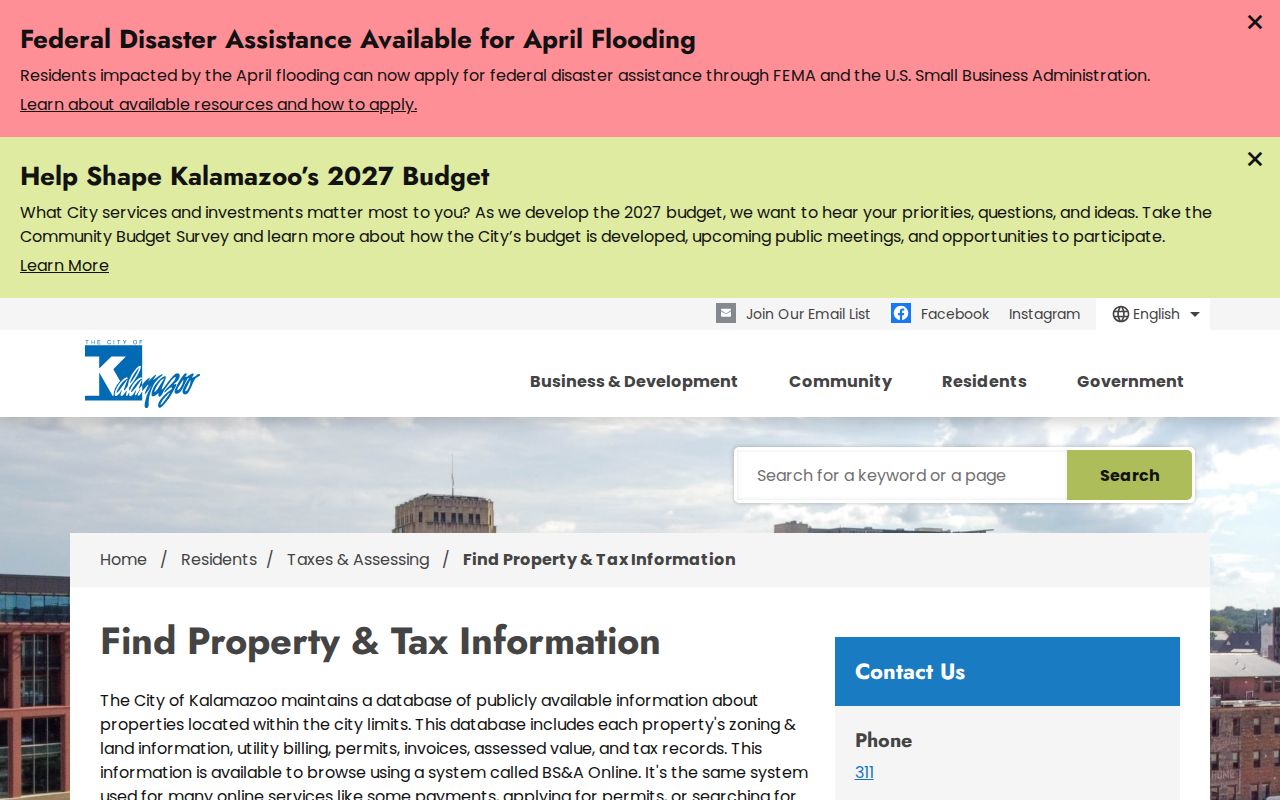
Read the year beside each value. A current assessment paired with an older sale measures two different dates and two different events.
Michigan's Fifty Percent Level
Assessed value and state equalized value usually represent 50 percent of true cash value. That ratio is a legal level, not a pricing rule. A home will not necessarily sell for double its assessed figure. Mass assessment groups many parcels. An open-market sale reflects one property and one transaction. County Equalization reviews local totals. The municipality keeps the current parcel roll. Use the local card for one Kalamazoo County property value and county reports for broad context.
Check a Kalamazoo Assessed Value
Anchor the search to one parcel and one year. County Parcel Search accepts owner, parcel ID, and street, while the local BS&A card supplies the detailed value fields.
- Search the address in County Parcel Search and copy the parcel ID and municipality.
- Open the municipal BS&A record and note assessed, SEV, taxable value, class, and year.
- Read sale history, then confirm the transfer through the county deed index.
- Record whether a transfer or exemption changed the tax base.
- Assessed value
- The value assigned under Michigan's property-tax system.
- Market value
- An estimate of likely open-market value, not a guaranteed price.
- Assessment ratio
- The relationship between assessed value and true cash value.
Kalamazoo Sale Price Evidence
BS&A sale history is a clue. The recorded deed is the transfer source. Kalamazoo County Deeds Search offers party, date/type, liber/page, instrument, and parcel fields. Weigh stated consideration and transfer-tax evidence in context. An estate, family, or partial-interest conveyance may not resemble an ordinary sale. The Register records instruments but does not rule on validity or supply an appraisal. Note deed type, transfer date, interest conveyed, and market fit.
Kalamazoo Taxable Value Changes
Michigan's cap can hold taxable value below assessed value. A transfer uncaps it for the following assessment cycle. The seller's prior tax base and the buyer's later figure can then diverge sharply. The Principal Residence Exemption affects tax treatment only. It leaves true cash value and deed consideration untouched, so similar homes can carry different taxable values.
Annual Kalamazoo Assessment Timing
Local assessors update the roll through the annual cycle. Kalamazoo's Board of Review hears valuation appeals in March. July and December sessions handle specified corrections. The displayed value belongs to a set tax year, not today's market. Portage's residential zoning change took effect August 28, 2026, but zoning adds use context rather than a sale price.
Context Around Kalamazoo Values
GIS aerials, wetlands, soils, and historic-district layers explain facts that a number omits. Portage aerials reach back to 1939. Kalamazoo lists six local historic districts and eleven single resources. These layers are clues, not automatic dollar adjustments. Compare property class, building detail, location, and date. Do not turn a county average into a parcel estimate.
Date Kalamazoo Value Evidence
The county parcel layer syncs with the tax roll each year. That helps match geography to one broad assessment cycle. For the freshest owner and value fields, Kalamazoo County points searchers to the city or township assessor. Save the tax year. Save the access date too. A later map refresh does not prove a value changed. An older aerial does not date an improvement. Permit history can explain why two dated values differ. Kalamazoo and Portage BS&A records may show permit issue and inspection dates beside land, building, sale, and tax tabs. A permit documents authorized work, not its condition, final cost, or exact effect on market value. Match the project date to the assessment year, and ask the municipal assessor when a material change entered the roll.
Kalamazoo Value Record Limits
An assessor value is a mass-appraisal number built for the tax system. It serves the tax roll, not the market. Treat it as a starting point rather than a promise of price, condition, or clear title. Deed consideration carries its own limits. Some transfers are not arm's-length sales at all. So a recorded amount may reflect a family gift, a foreclosure, or a partial interest.
Line up the dates before anything else. An assessed value belongs to one tax year. A deed consideration belongs to one transfer. A permit sits inside a project timeline. Combining figures from different dates turns ordinary gaps into false contradictions. Log everything in a single worksheet. Include parcel number, municipality, value label, value year, transfer date, deed type, and the source access date.
Property class and site detail shape the numbers too. Two Kalamazoo County parcels on the same street can differ in lot size, improvements, exemptions, ownership history, or legal constraints. A nearby sale stays context until the terms and features are checked. Historic-district, wetland, soil, zoning, and aerial layers raise good questions. None of them produces an automatic adjustment to a Kalamazoo County property value.
Consideration in deed records can mislead without the instrument type. Trustee, executor, quitclaim, family, partial-interest, and foreclosure-related deeds each carry circumstances that weaken a simple price comparison. Read the transfer-tax or exemption information first. The Register of Deeds makes every filing public. It does not rule on validity or on whether a sale makes a sound comparable.
Taxable value has the narrowest purpose of all. Michigan's cap can hold a taxable base down through one ownership period. And a transfer can uncap it for the next assessment cycle. PRE status changes the tax bill too. None of that predicts what a buyer would offer. For bills, exemptions, and appeals, see Kalamazoo County property tax records , actually, start there. And keep each number tied to its source. Good value research ends by knowing what each figure means.
Online access is one channel among several. County Parcel Search supplies the gateway and municipality, while a municipal BS&A record holds the detailed roll where offered. If the portal fails or a field confuses you, call the municipal assessor. County Equalization explains countywide equalization data but does not replace the local current roll. A deed image from the Register of Deeds gives transfer evidence. The public workstations at 201 W. Kalamazoo Avenue offer a counter fallback. Older plats, deed books, local tax rolls, aerials, and library sources can trace how a parcel changed over time. None converts a historical figure into a current appraisal.
Compare several Kalamazoo County property values on a consistent grid. Give each parcel one row with columns for municipality, class, land detail, building detail, assessed value, SEV, taxable value, PRE status, assessment year, last transfer date, deed type, and stated consideration. Never mix a current roll for one parcel with an older roll for another. Mark missing fields instead of guessing. That discipline shows whether a difference comes from the property, the year, the transfer, or the taxable-value cap.
Value is not price. Assessed value supports taxation and is not a sale-price prediction or licensed appraisal.